Saints’ medals & protective crosses
Meaning
Medals and crosses carried a saint's or Christ's protection: the St Benedict medal with its exorcism letters (C.S.P.B., V.R.S.N.S.M.V., 'Begone Satan!'), the double-barred Caravaca cross, the Scheyern cross, the Miraculous Medal of Paris, and scapulars.
Intent
They were worn against the devil, witchcraft, storms, plague and sudden death, and for a good death and salvation. The Benedict medal was also buried in fields and set into foundations.
Significance
Blessed medals are the Catholic Church's sanctioned alternative to charms (sacramentals, not magic), and they are the most widely worn protective objects in the Catholic world today.
History
The St Benedict medal formula dates from a 1415 manuscript and the medal was approved by Benedict XIV in 1742. The Caravaca cross comes from a 13th-century legend in Murcia. The Miraculous Medal dates to Catherine Labouré's vision in 1830.
Making yours
Die-struck or cast brass, pewter or silver, 1.5–5 cm. The St Benedict medal carries its letters C.S.P.B. and V.R.S.N.S.M.V.Medieval & Early Modern Europe: the tradition
Medieval Europe held two protective systems at once: the Church's sacramentals (relics, blessed wax, saints' medals, written prayers) and an older 'natural magic' of stones, herbs and animal parts inherited from Pliny and the lapidaries of Marbode of Rennes (c. 1090) and Albertus Magnus. Pilgrimage produced millions of cheap lead badges. Renaissance courts wore toadstones and bezoars set in gold, and Protestant reformers attacked both relics and charms. In Catholic Bavaria, Austria, Italy and Spain the folk tradition survived into the 20th century, recorded by collectors like Leopold Kriss-Rettenbeck and Rudolf Kriss, whose collections are now in Munich, and by Walter Hildburgh, who gave thousands of Spanish and Italian amulets to the V&A.
![Initial S[alve sancta parens] with the Virgin Adored by Angels, and Singing Benedictine Monks: Single Leaf from a Gradual](../img/g/483f633c8a617f.webp) Initial S[alve sancta parens] with the Virgin Adored by Angels, and Singing Benedictine Monks: Single Leaf from a GradualSouth Italy, 13th century · c. 1270
Initial S[alve sancta parens] with the Virgin Adored by Angels, and Singing Benedictine Monks: Single Leaf from a GradualSouth Italy, 13th century · c. 1270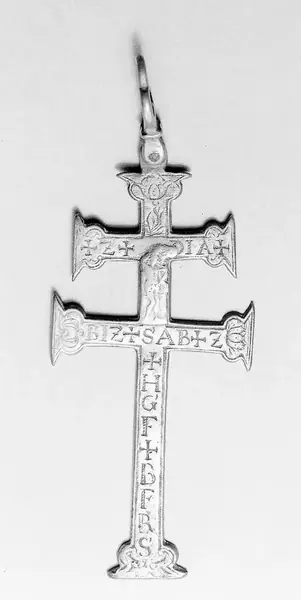 Zachariah's cross. A double cross, on one side side Zacharias and his blessing, on the other St. Benedict and the lettering of the cross of St. Benedict. Protection against the plague.United Kingdom
 Scheyrer cross, a double cross with lettering.Germany
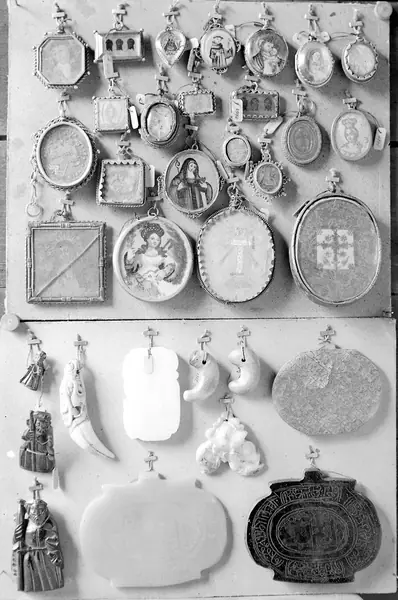 2 groups of Catholic pilgrimage medals & Spanish amulets.Spain
 M0016769: Spanish amulets: cross of Caravaca
 Spanish amulets; Cross of Caravaca
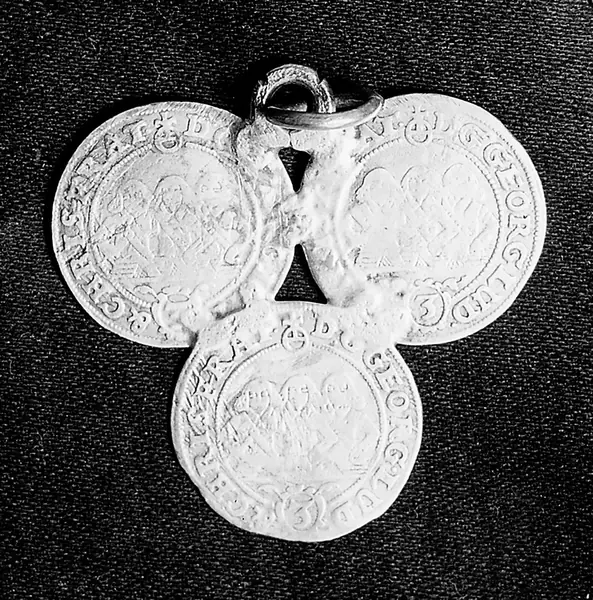 M0016852: Three silver coins joined to form a triangle / M0016853: St. Benedict's penny with a representation of the saint / M0016854: The cross of St. Ulrich: Maltese shaped cross, with scene showing
 Cruz de Caravaca 2
 A rosary, a medallion of St Benedict, a charm said to cause loss of eyesight, and hands showing lines and features to be interpreted by palmistry (including lines forecasting violent death); all illus
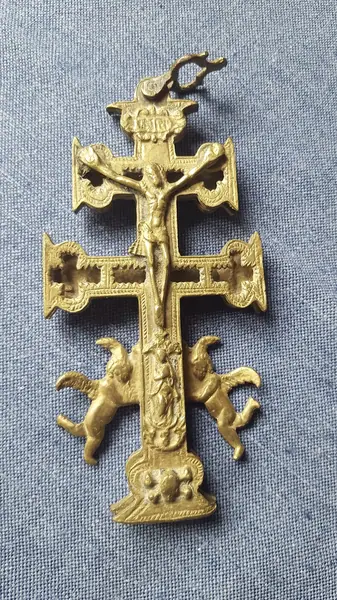 Cruz de Caravaca 1
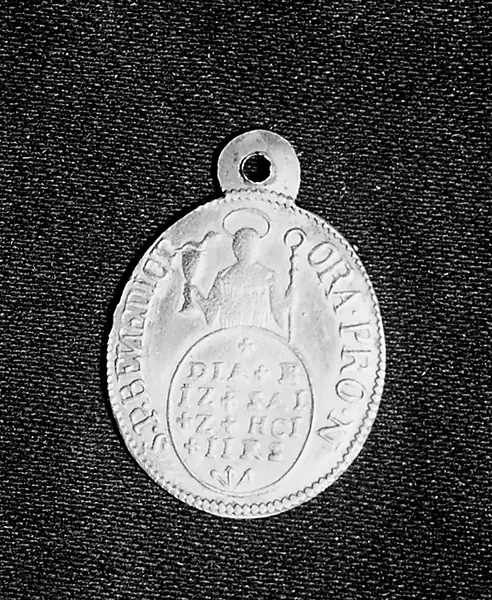 St. Benedict's penny. On one side a representation of the Saint.
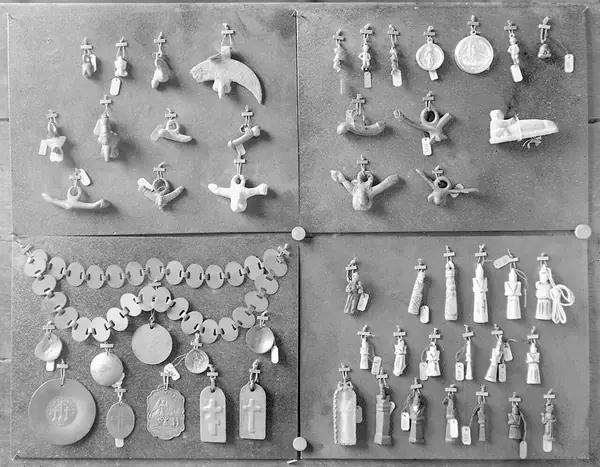 4 groups of Pilgrimage medals & votive amulets.
 St. Benedict's penny.
More from Medieval & Early Modern Europe: Pilgrim badges · Reliquary pendants & devotional lockets · Agnus Dei waxes · Magic & inscribed rings · Natural magic: toadstones, bezoars, serpent tongues · Fraisenketten & Charivari (charm chains) · Breverl & paper blessings · Coral teething rattles & child charms · Coral amulets · Wax & metal votive offerings · Other & unsorted Medieval
Every type in the gallery
Anything in the gallery can be made: any piece, any tradition, in its own material or yours, by hand from the documented original. Numbered. Price on commission, quoted before anything is made. I reply within one business day.